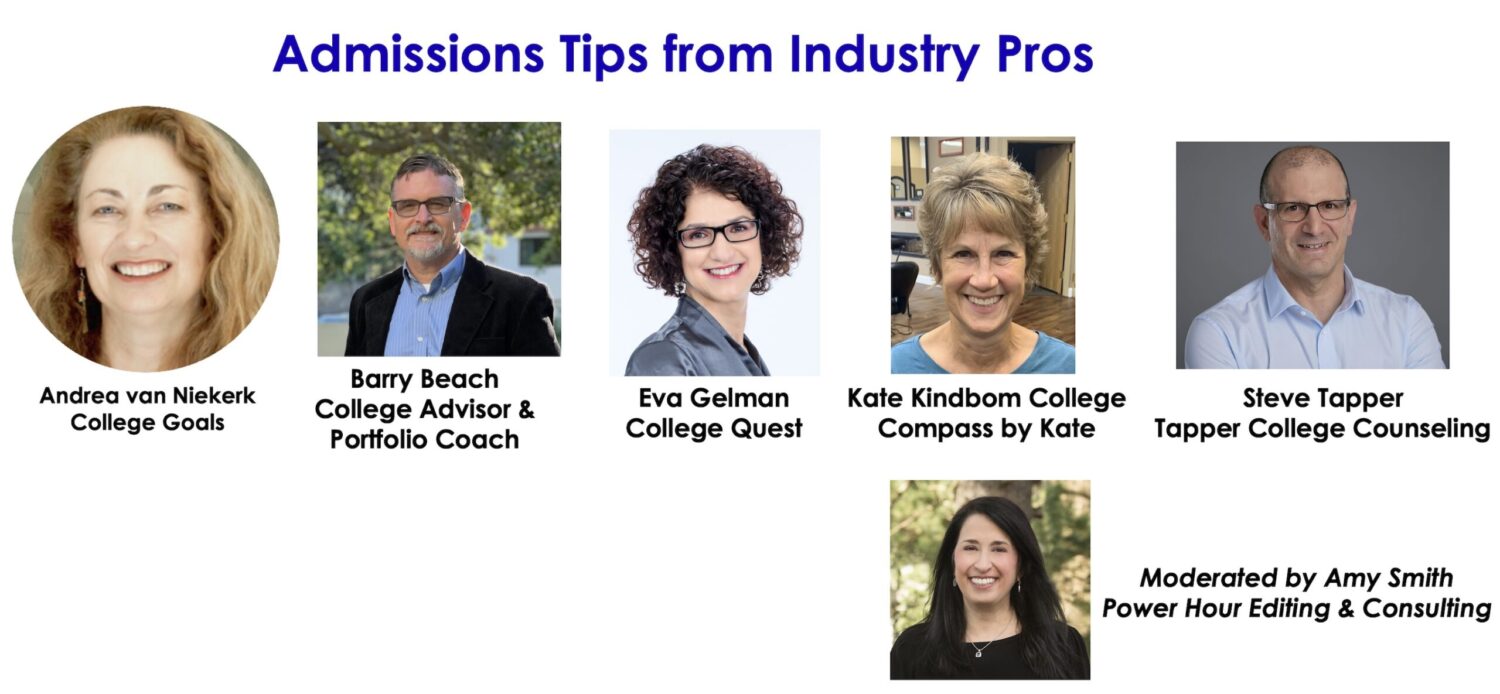
I recently hosted a webinar for HECA (Higher Education Consultants Association), where I interviewed five current/former application readers. With the surge in college applications (4 million predicted this cycle), admissions has become more competitive than ever before.
Each panelist has a private counseling practice, and this wasn’t about university-specific advice but rather general application tips. I’ll share some highlights here.
What Would You Advise YOURSELF When Applying to College?
I asked our panel to share tips they’d give to their high school junior self, along with a throwback picture.
Here’s mine:
 Amy Smith: Forget about what seems right for you based on what others think. Go for your North Star. Your choices, classes, activities, hobbies, and passions likely point to something that makes sense for you. Research is power. Use it to avoid a course correction later.
And tips from our panelists…
Andrea van Niekerk: Applying to college is kind of just like attending college. Stressing about it doesn’t actually change the outcome, but that experience that you’ll have at college — intellectual, social, personal — will actually be determined by the choices you make. The choices to jump into things and take risks at college rather than by where you choose to apply.
Barry Beach: Slow and steady wins the race. I’m an artist, and I’ve been making art since my undergraduate years. Find that passion, and stick with it if it makes you happy.
Eva Gelman: Trying new things, connecting with people who think differently, and really believing that what happens outside the classroom oftentimes is more important than what happens in it. Take advantage of those opportunities. It’s not where you go, but what you do while you’re there (that) is really important.
Kate Kindbom: Visit as many different types of colleges as you can, even if they’re local, before you decide where to apply. Visit urban, suburban, rural, large, medium, small, faith-based, if that’s a factor for you, and public universities to inform your application decision. Then apply to no more than five or six. You can only go to one.
Steve Tapper: I felt like my college search process was a little bit too focused on prestige, and I didn’t do enough research on the colleges I applied to. I did a pretty good job for a few, and the one I ended up going to, which was my top choice all along, but a couple of others I applied to, I didn’t end up getting into anyway. I wondered what was I even thinking? Those would not have been good fits for me. I wouldn’t have been happy there.
There was a TON of consensus on the call, which I loved. Some tips were mentioned by multiple panelists that are VERY consistent with my experience and advice:
- The read time is SHORT. I’ve always heard 7-10-12 minutes total per application, and our panelists pretty much agreed with that.
- The review process is a team effort. For the most part, more than one person reviews each application, with final decisions happening in a committee setting.
- Context is so important. Don’t raise red flags. If something needs to be explained, DO IT!
- Learning/aha moments are a lot more compelling than simply reporting facts.
- Every college has its own “scorecard” that determines what’s important to assess admission, along with institutional priorities. A college wants to be sure a student can succeed academically AND contribute to the school’s community.
Amy’s advice: Since you can’t see behind the curtain to know EXACTLY what each college wants, you need to do well throughout your application. Make sure each “puzzle piece” fits together to tell the story of YOU! I refer to this as “connecting your dots.”
Tone Matters & First Impressions Count
Van Niekerk suggested considering tone, that a strong application is connected by a complete narrative. She explained, “This doesn’t mean hitting the same point over and over or doing the same stuff in an application — but if they can read your application and get a sense that it’s the same kid in every one of those little facets, I think that…allows your strength to resonate throughout an application. It amplifies it, and it makes for a stronger application.”
Gelman pointed out that first impressions count, reinforcing how important it is to be polished with grammar and email etiquette. She also mentioned how important it is to follow directions: “There are reasons for word counts. There are reasons that letters of recommendation count. Admissions wants students to respect those instructions and requirements.” Also, great Gelman tip: “Accept uncertainty and unpredictability. Control what you can, right? Students have control of certain things in the application, and they do not have control over other things.”
Amy’s advice: YES! I agree! So much is already written in “permanent ink” – grades, test scores, etc. Focus on what you CAN control: essays, supplements, and how you report your activities.
Essays = Something You GET To Do!
Gelman also stressed the importance of essays and what stands out. She acknowledged that writing in the first person about themselves isn’t always easy for students, but that mindset matters. She explained a great attitude to use to approach the writing parts of the application: “I get to, versus I have to.” Students, she said, GET to present themselves, and every essay is an opportunity.
Similarly, Beach considers the college essay a very limited opportunity in a small timeframe. His advice: “Demonstrate the things that make you tick, the things that you’re excited about, the things that you’ve learned, your big-picture aha moment, your great experience from a summer job or a fantastic learning opportunity where you fell flat on your face, but my gosh, you learned so much.”
Supplements + The WHY Essays
Kindbom recommends that students “save bandwidth for supplemental essays” and mentioned how important it is to support a WHY essay with specifics versus generalities. She explained, “Don’t spend your time complimenting the school. Talk about why you will be a great fit.”
Amy’s advice: YES! I call general info in supplements a “brochure drop.” The school knows EXACTLY what they offer; what they don’t know is WHY it’s relevant to YOU! Connect those dots!
Another supplemental essay available to ALL applicants is the Additional Information response. Tapper recommended, “Don’t leave questions unanswered. So if a student had a bad grade or a bad semester, or if they couldn’t take an AP class due to some scheduling conflict, you don’t want colleges to wonder about that. You want to use the additional information section to explain it.”
That’s all for now! I hope this helps you frame YOUR narrative in a way that makes sense for YOU.
Here’s the full interview:
https://shorturl.fm/R8ALF